

4×
more firmware bugs fixed on the first flash
3.8×
fewer tokens on average, up to 13× on individual tasks
Same model
both agents ran Claude Haiku 4.5, identically configured
Setup
IoT-FirmwareDebugBench v0.1 runs on real nRF52840 DK and nRF52832 DK boards with NCS v3.2.1 (Zephyr 4.2.99). Six BLE-focused tasks across three difficulty levels, each with a precisely injected bug, a defined reproduction procedure, and a known correct fix. Both agents run the same model, Claude Haiku 4.5, reasoning disabled, caching identical. This isolates one variable: the architecture around the model, not the model itself. Difficulty. L1: root cause readable in logs. L2: inference from BLE behavior or Kconfig. L3: correlating state across two devices or full session timelines.Results
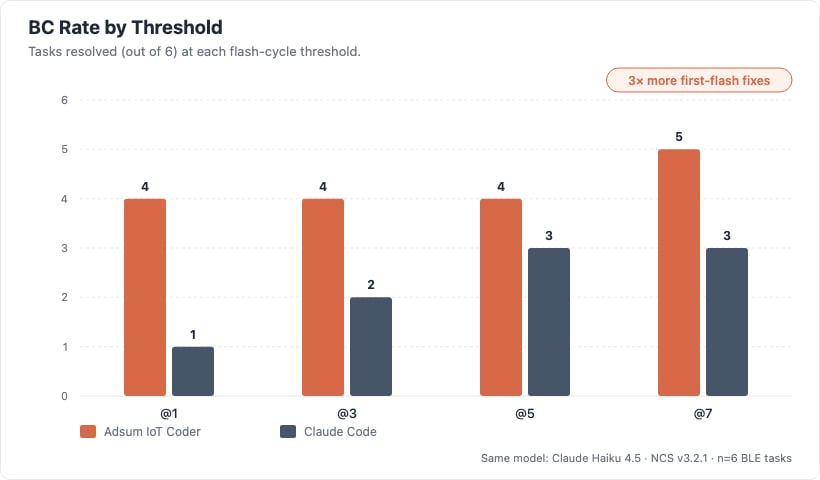
Bug-closed rate by flash threshold (BC@k = bug closed within k flashes).
What the gap shows
- The loaded workflow makes log capture a first-class step, not one the agent can skip under pressure.
- On one task the baseline burned 27M tokens and lost the original symptom; Adsum resolved it at a 148.7k-token peak.
- The gap widens with difficulty: parity at L2, Adsum 1/2 vs 0/2 at L3.
Watch it head to head
Both agents, same model, same real embedded bug:Full benchmark report
Per-task breakdown, limitations, and how to run it yourself.